

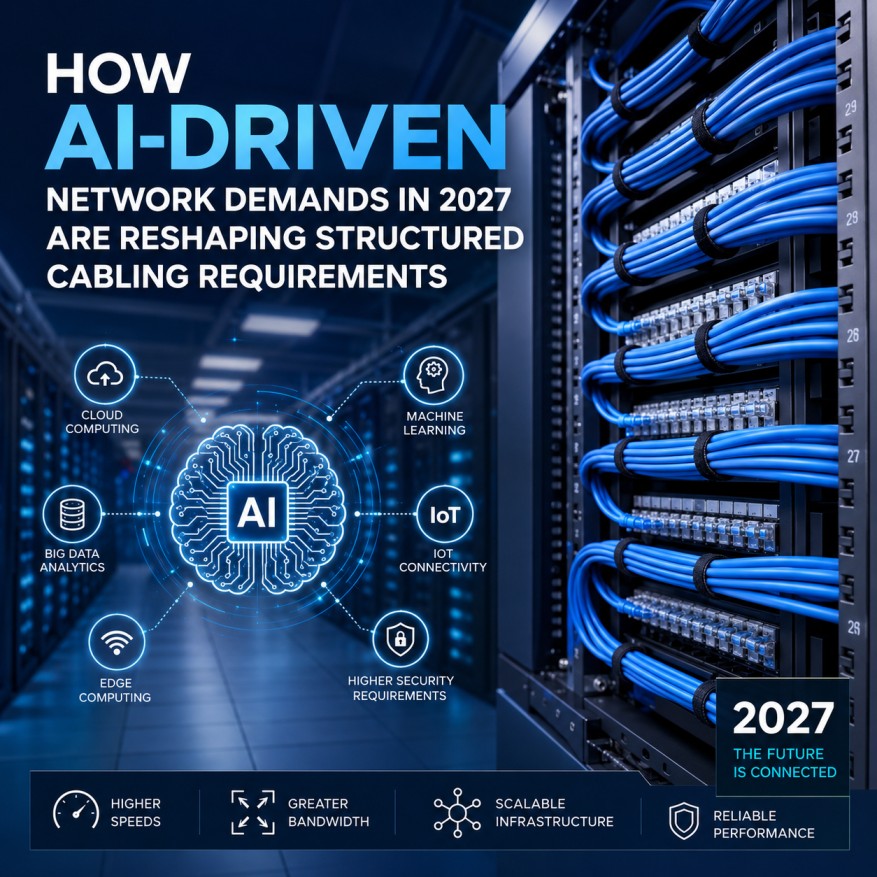
Artificial intelligence is changing how businesses think about network infrastructure. What used to be enough for email, cloud storage, VoIP, CCTV, access control, and office Wi-Fi may not be enough for AI-assisted workflows, smart surveillance, data-heavy applications, automation tools, real-time analytics, and high-performance cloud platforms.
By 2027, network demands are expected to be shaped more strongly by AI workloads, higher data movement, lower latency expectations, and greater device density. For businesses in Dubai, this means structured cabling installation should no longer be treated as a basic IT setup. It should be planned as long-term digital infrastructure.
Why AI Is Putting Pressure on Networks
AI tools are not only used in large data centres. They are entering offices, warehouses, clinics, retail stores, schools, logistics facilities, and smart buildings. Businesses are using AI for video analytics, customer support, inventory systems, cybersecurity, predictive maintenance, document processing, collaboration tools, and automation.
At a larger infrastructure level, AI is already increasing demand on data centres. Gartner has forecast that AI-optimised servers could use more electricity than conventional servers by 2027, showing how quickly AI infrastructure needs are expanding. AI data centre networks also need high bandwidth, low latency, and reliable connectivity across dense computing environments, especially as 400G and 800G networks become more common.
Even if a company is not building an AI data centre, this shift affects enterprise networks. More devices, heavier applications, smarter cameras, faster wireless access points, and cloud-based AI platforms all depend on stable physical cabling.
Structured Cabling Is the Foundation
Wireless networks, cloud tools, CCTV systems, IP phones, access control, servers, and workstations all rely on the cabling layer behind them. If the cabling is poorly designed, the rest of the network will eventually show problems through slow speeds, dropouts, weak connectivity, messy troubleshooting, and limited upgrade options.
A strong structured cabling system gives businesses a planned network backbone. It organises cables, patch panels, racks, data points, server room connections, floor-level distribution, and device connectivity in a way that is easier to manage and expand.
Supercad supports structured cabling installation for businesses in Dubai, including cabling systems for enterprise networking, Wi-Fi, IP telephony, CCTV, and access control.
What AI-Ready Cabling Needs to Support
AI-driven business environments need cabling that can handle more than current usage. The system should be ready for higher data loads, more connected devices, and future network upgrades. This is especially important for offices, commercial buildings, warehouses, clinics, schools, hotels, and industrial facilities where technology is becoming more connected every year.
Key requirements include:
- Higher bandwidth capacity to support faster switches, wireless access points, servers, and AI-enabled applications.
- Lower latency for real-time tools such as video analytics, cloud platforms, smart security, and automation systems.
- Scalable cabling design that allows future device additions without major rewiring.
- Better rack and cable management to reduce downtime and simplify maintenance.
- Proper testing and certification so the installed system performs as expected.
More Devices Mean More Planning
AI adoption usually increases the number of connected systems inside a building. A smart office may need access points, IP phones, laptops, meeting room systems, biometric devices, cameras, displays, sensors, and cloud-connected hardware. A warehouse may need scanners, CCTV, access control, automation equipment, tracking systems, and wireless coverage across large areas.
If cabling is planned only for today’s device count, the business may face expensive rework later. Extra data points, backbone capacity, rack space, cable pathways, and switch planning should be considered before installation begins. A structured system is easier to expand than a patchwork network built one urgent cable at a time.
Wi-Fi Performance Still Depends on Cabling
Many businesses focus on wireless speed but forget that access points still need strong wired connections. As Wi-Fi standards improve and more users connect to cloud-based tools, each access point may need higher backhaul capacity and reliable Power over Ethernet support.
This makes cabling design important for wireless performance. Poor cable quality, weak termination, badly placed network points, or limited switch capacity can reduce the performance of even high-end access points. For AI-enabled offices and smart buildings, wireless planning and structured cabling should be handled together, not as separate decisions.
CCTV and AI Video Analytics Need Reliable Infrastructure
AI-powered surveillance is another area reshaping cabling requirements. Traditional CCTV systems recorded footage for review. Modern systems may support motion detection, facial recognition, number plate recognition, people counting, behaviour analytics, and real-time alerts.
These features increase the importance of stable network connectivity. Cameras need proper cabling, switch capacity, bandwidth planning, storage connectivity, and reliable uptime. For buildings using CCTV alongside access control and monitoring systems, structured cabling helps keep the infrastructure organised and serviceable.
Future Upgrades Should Be Easier, Not Painful
A business may not need the highest network capacity today, but it should avoid installing cabling that becomes outdated too quickly. AI adoption is still growing, and by 2027 more businesses are likely to depend on AI-supported software, smart devices, and cloud-based automation.
Good cabling design should make future upgrades easier. That may include planning for higher-grade copper cabling where suitable, fibre backbone connections between floors or buildings, properly labelled patch panels, spare capacity in racks, and clean cable pathways. It should also include professional testing so businesses know the network is ready to perform.
For Dubai businesses comparing structured cabling companies in Dubai, the right partner should understand both current network needs and future technology growth. AI-driven demand is making cabling more important, not less. Faster applications, smarter devices, stronger Wi-Fi, cloud platforms, CCTV analytics, and automation systems all depend on the quality of the physical network foundation.
Supercad supports structured cabling installation for offices, commercial spaces, and business facilities in Dubai, with cabling solutions designed for networking, Wi-Fi, IP telephony, CCTV, access control, and future-ready infrastructure. A well-planned cabling system helps businesses reduce network issues, support AI-ready workflows, and avoid expensive rewiring when technology demands increase.