

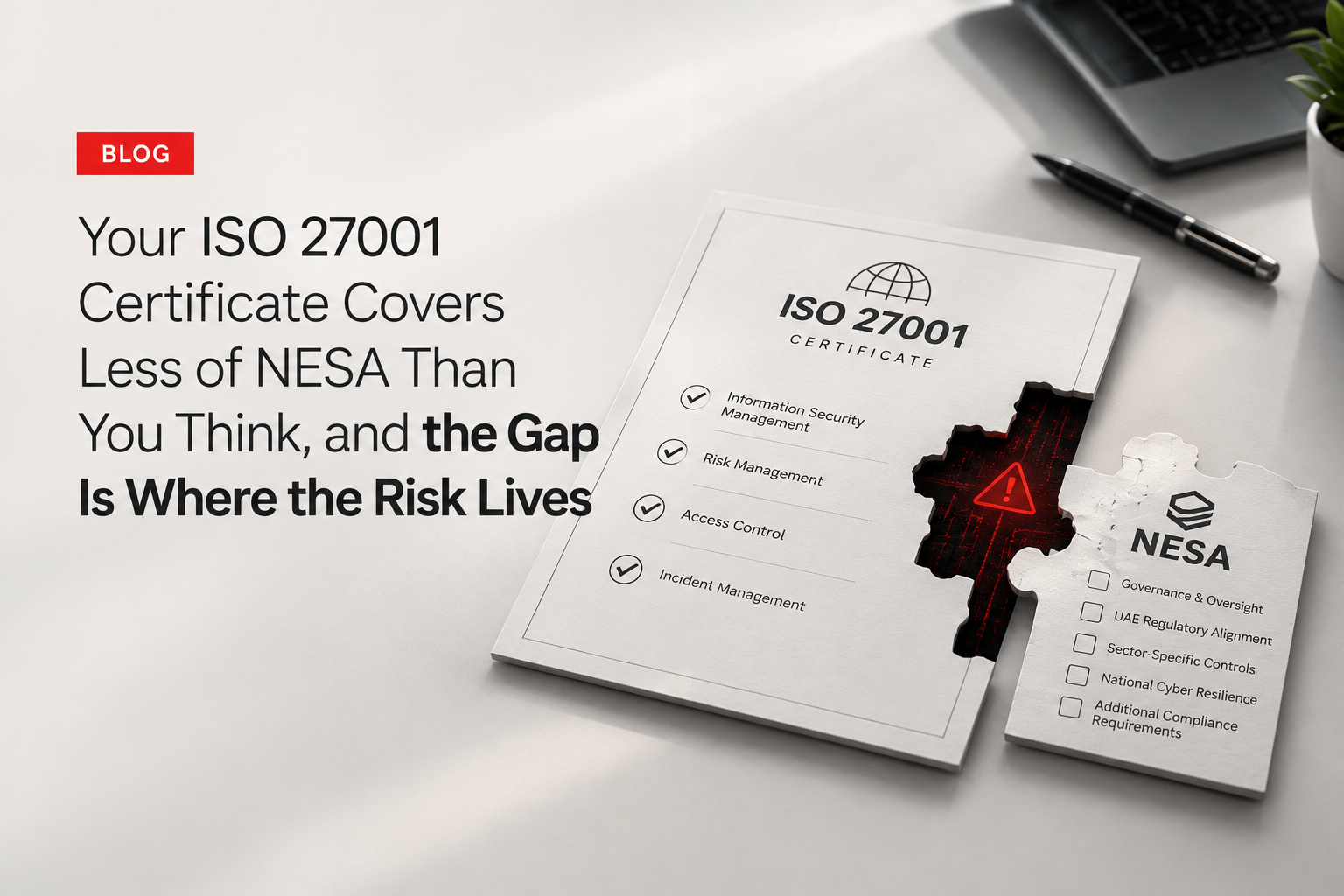
There is a comfortable assumption in a lot of UAE boardrooms: we hold ISO 27001, so our cybersecurity is handled. It is an understandable belief. ISO 27001 is a serious, globally respected standard, and earning it takes real effort. But in the UAE’s current regulatory environment, that certificate covers less ground than most organisations assume, and the part it does not cover is precisely where the sharpest risk sits.
For any business subject to the UAE’s national cybersecurity requirements, understanding this gap is not academic. It is the difference between believing you are compliant and actually being so.
Two frameworks that are not the same thing
The UAE’s Information Assurance Standards, developed by the national cybersecurity authority now operating under the Signals Intelligence Agency, set the federal baseline for protecting critical information and infrastructure. This framework is often still referred to by its long-standing name, NESA, and it runs to a large set of controls spanning both management and technical domains.
ISO 27001 and this national standard overlap heavily, but they are not interchangeable. A well-implemented ISO 27001 system addresses a large share of the national requirements, but not all of them. Industry practitioners consistently put the coverage at somewhere around three-quarters, which sounds reassuring until you consider what the remaining quarter contains.
Where the gap actually is
The shortfall is not random. It clusters in the UAE-specific requirements that an international standard was never designed to address:
- Data residency, meaning where certain data can legally be stored and processed, which is a national concern that a global standard does not dictate.
- Mandatory incident reporting through the UAE’s national channels, including reporting to the national computer emergency response team, on the timelines and in the manner the regulator expects.
- Integration with national threat intelligence, so an organisation is drawing on and contributing to the UAE’s own picture of the threat landscape.
- Deeper technical controls in areas such as network security and operational technology, where the national standard often demands more evidence than ISO typically requires.
These are not minor footnotes. They are the controls a generic international consultant is least equipped to deliver, because they require specific knowledge of the UAE regulatory structure. An organisation can hold a valid ISO 27001 certificate and still have meaningful gaps against the national standard, sitting exactly in these areas.
Why the gap matters more in 2026
This would be a manageable technicality if enforcement were relaxed. It is not. The UAE has moved decisively from voluntary guidance toward mandatory, actively enforced cyber resilience, with expectations of continuous monitoring and evidence readiness rather than a once-a-year review. At the same time, accreditation requirements are tightening around who is even permitted to provide cybersecurity services to critical infrastructure. In that climate, an unnoticed gap is not a paperwork issue. It is exposure, both to regulators and to the attackers those controls exist to stop.
Closing the gap, not just documenting controls
The practical response is a structured gap assessment that maps what an organisation already has, typically its ISO-aligned controls, against the full national requirement, and then a prioritised plan to close what is missing. That work runs from governance down to technical enforcement, where controls like properly configured network firewalls and segmentation stop being line items on a checklist and become the actual mechanisms containing a threat. The regulator increasingly wants to see controls validated and working, not merely written down.
The organisations that treat this seriously find that closing the gap does more than satisfy a regulator. It genuinely hardens them against the threats the standard was built to address, which is the entire point.
Supercad works as a cybersecurity company in Dubai that understands where ISO 27001 ends and the UAE’s national requirements begin, and how to close the gap in between with validated technical controls. If your certificate has been giving you a false sense of security, let us show you what it is missing.