




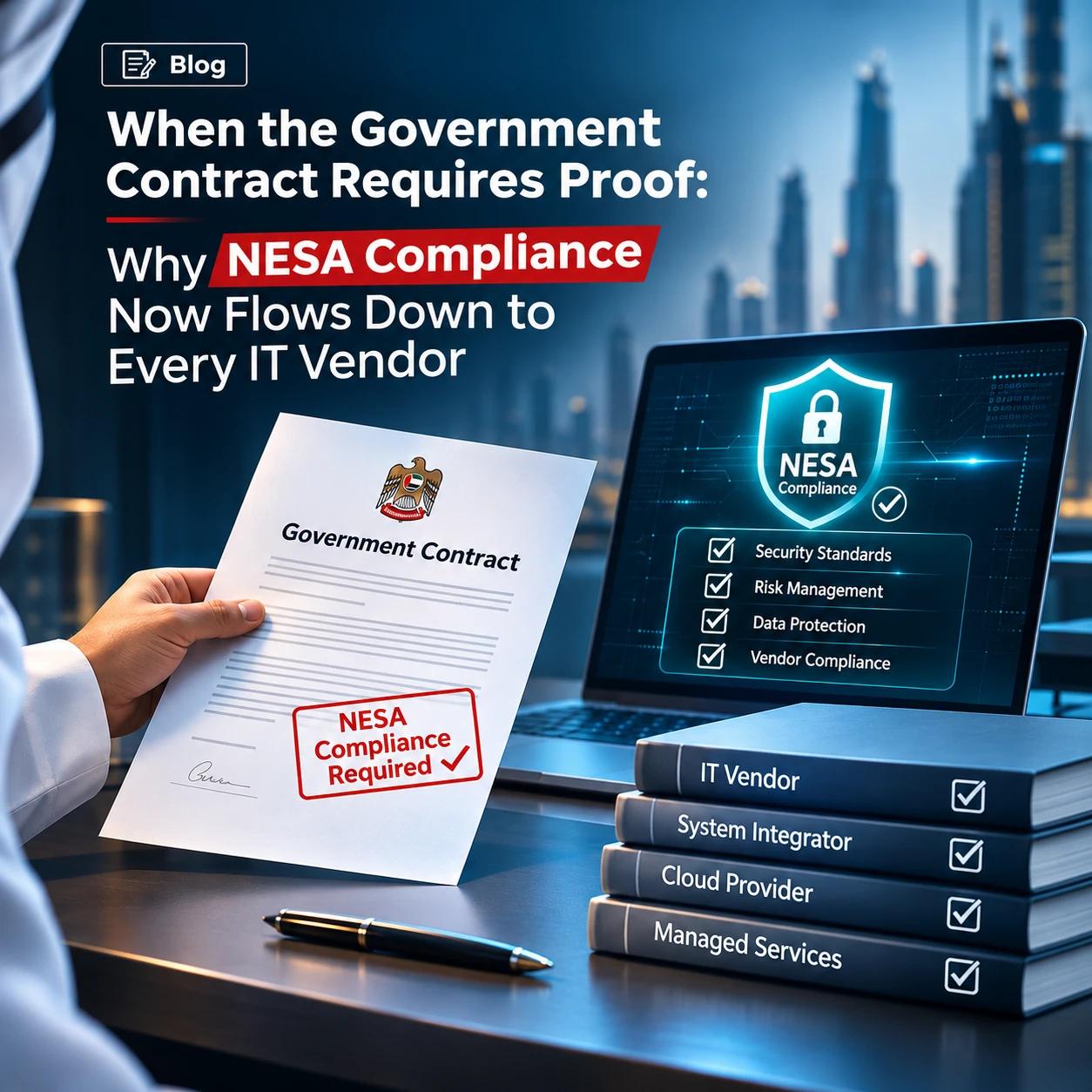
When the Government Contract Requires Proof: Why NESA Compliance Now Flows Down to Every IT Vendor
Why national cybersecurity expectations are travelling from government and regulated clients down to every IT, cloud and managed-security vendor they use.
All Blogs3 min read
For years, a mid-sized IT services company in the UAE could treat national cybersecurity regulation as someone else's concern, the domain of banks, government departments, and critical infrastructure operators. That distance has closed. In 2026, the compliance expectations placed on those large, regulated entities are flowing straight down their supply chains, and the businesses that serve them, including IT, cloud, and managed-security providers, are now being asked to prove their own compliance as a condition of the contract.
If your business supplies, or wants to supply, the public sector or regulated industries, your security posture has quietly become part of your sales proposition.
How the requirement travels down the chain
The mechanism is simple and contractual. Government and semi-government entities are bound by the UAE's national Information Assurance requirements. To meet them, they have to be confident that everyone with access to their systems and data meets an equivalent bar. So they write that expectation into their vendor contracts. If you provide managed IT services, managed security, or cloud infrastructure to a regulated entity, you should now expect to be asked for evidence that your own operation is compliant.
This turns compliance from an internal matter into a market-access question. A provider that cannot demonstrate it becomes a risk the client cannot take on, regardless of how good the service is otherwise. A provider that can demonstrate it removes a barrier before the conversation even starts.
Why this reshapes vendor selection
The downstream effect is that regulated clients are re-examining who they work with, and the criteria have shifted. What used to be a decision about price and capability now includes a hard compliance filter:
- Can the vendor evidence alignment with the UAE's national security standards, not just general good practice?
- Does the vendor hold the accreditations that are increasingly required to serve critical or regulated environments?
- Can the vendor support the client's own continuous-monitoring and incident-reporting obligations rather than undermining them?
- Is the vendor a source of assurance in the client's supply chain, or a weak link that increases the client's exposure?
A managed services provider that has done this work internally is not just compliant. It is easier to buy from, because it makes the client's own compliance simpler rather than harder.
The competitive asset hiding in compliance
Here is the reframing that matters for a UAE IT provider. Compliance is usually seen as a cost and a burden. In the current procurement environment, it is closer to a competitive asset. When a regulated client is choosing between vendors, the one that can walk in already able to evidence its posture wins on a dimension the others cannot even compete on. Compliance accelerates deal approvals rather than slowing them, and it opens doors that stay closed to providers who treated it as optional.
The reverse is also true, and worth stating plainly. A provider that ignores this risks being quietly removed from procurement lists, not through any single dramatic event, but simply by being unable to answer the compliance questions that now come as standard.
Building it in before you are asked
The providers positioned to win are the ones treating their own compliance as core infrastructure, not a scramble triggered by a client's questionnaire. That means getting their managed IT and managed security operations aligned with the national requirements in advance, so that when a regulated client asks for proof, the answer is ready. In a market where the biggest and most stable contracts sit with regulated entities, that readiness is one of the more valuable things an IT provider can build.
Supercad delivers managed IT and managed security services in Dubai with the compliance posture that regulated clients now require from their vendors. If your next big contract depends on proving you are secure, make sure the answer is ready before the question comes. Talk to us.
About Supercad
We, at Supercad Trading LLC, are your go-to IT consultancy firm in UAE that brings you cutting-edge IT, Consulting, and Trading Solutions.